
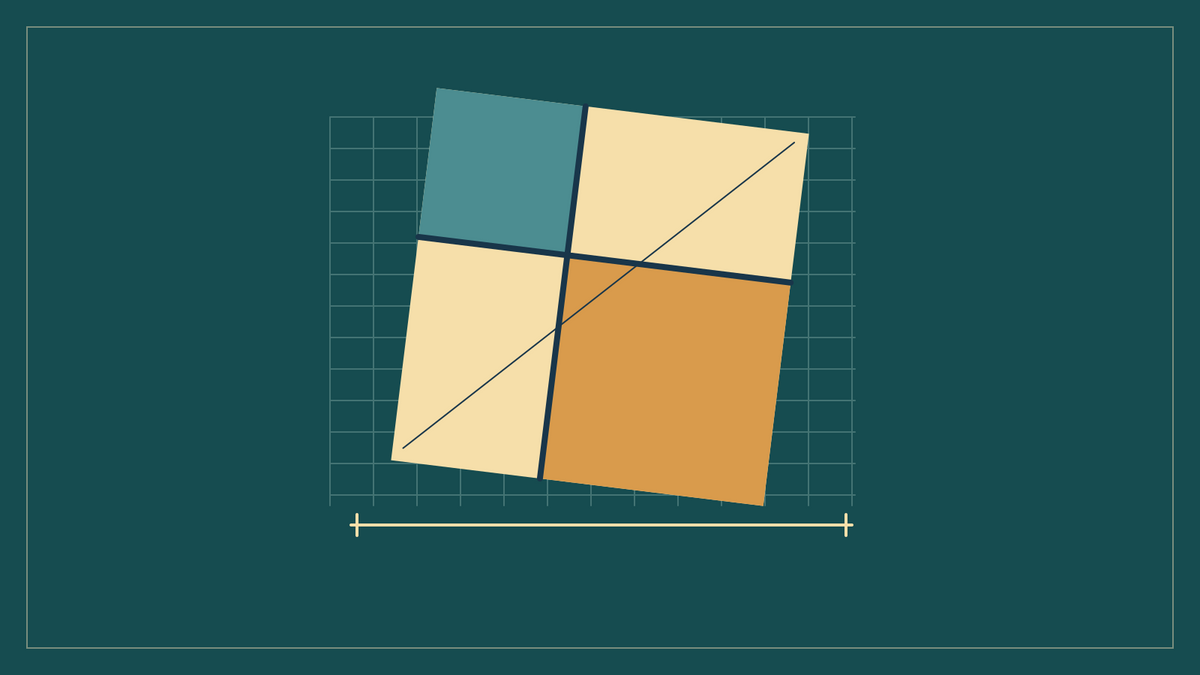
A mathematician in ninth-century Baghdad asks for a square which, together with ten of its roots, makes thirty-nine. To a modern reader it sounds like a riddle translated by someone with an unusual fondness for trees. The root here means the length of one side of the square. Put that way, the problem becomes something you can draw. Its author, Muhammad ibn Musa al-Khwarizmi, expected a reader to follow an argument in words and geometry, centuries before our familiar algebraic notation became standard.
Imagine a square of unknown side. Add two strips along adjacent sides, each as long as the side and five units wide. The area you have added is ten times the original side. Your drawing now contains thirty-nine units of area, but an obvious corner is missing. Fill it with a five-by-five square. The completed square has area sixty-four, so its side is eight. Remove the five units you added along one edge and the original side is three. Nine plus thirty is indeed thirty-nine.
Why a book like this had readers
Al-Khwarizmi wrote under the Abbasids, whose capital at Baghdad had become a meeting place for people with quite different reasons to value calculation. Dividing an estate, measuring land or arranging a commercial transaction could all require a person to recover an unknown quantity from known ones. A single numerical answer serves one customer. A procedure that explains which features of the problem matter can travel to the next town and serve somebody the author will never meet.
The title of his algebra book includes the word al-jabr, from which the English word algebra descends. Knowing that word's history is satisfying, but the more consequential inheritance is an author's decision about organization. A reader could learn to recognize a kind of problem beneath its particular numbers. Our symbols make it easy to miss how demanding that achievement was. A writer using sentences has to choose an order in which the reader can hold each quantity in mind and still understand what is being done to it.
Translation as a scholarly craft
Baghdad's intellectual life drew on a translation movement that brought Greek works into Arabic, often through Syriac, alongside encounters with Persian and Indian learning. Translators had to know enough about the subject to recognize when two manuscripts disagreed in a way that mattered. A word meaning “power” in ordinary speech might require a more precise rendering in medicine or mathematics. Copying the first plausible equivalent could leave generations of readers with an elegant but unusable sentence.
Hunayn ibn Ishaq, a Christian physician and translator working in the Abbasid world, is a reminder of the many communities involved. The adjective Islamic describes a historical setting in which Muslims, Christians, Jews and others could participate in a common scholarly language. It tells us neither the faith of every writer nor the language spoken in every household. A medical discussion could be carried on in Arabic by people who had first learned its terms through quite different linguistic routes.
Patronage helped make sustained work possible. A scholar comparing manuscripts needed access to copies, time to examine them and a reason to expect readers. Courts could provide all three, although a court's tastes and fortunes could change. The famous House of Wisdom has become a convenient emblem for the period. No single building, however well supplied, could account for the work of scribes, teachers, patrons and readers spread across cities and centuries.
What an instrument maker knew
Astronomy adds a participant who can disappear from a history written entirely around authors. An astrolabe represents parts of the sky on a handheld surface. Making a usable instrument involves turning geometrical relationships into carefully positioned markings and movable parts. A beautiful mathematical argument can survive a poorly drawn letter. A badly placed marking can quietly compromise every reading someone takes from an instrument.
Questions about time and direction gave such work practical importance, including for religious observance. Patrons interested in the heavens had other motives too, from navigation to astrology. People in the medieval world could pursue several of these interests together even when a modern museum displays the surviving object under a single heading. The object is evidence of a collaboration between abstract reasoning, skilled hands and users who had reason to care about the answer.
Why the sky needs more than one plate
An astrolabe becomes less mysterious if you imagine carrying one from one city to another. The stars have kept their positions relative to their neighbours, yet your view of their paths above the horizon has changed because you have changed latitude. An instrument maker has a design problem. Some relationships in the model of the sky can stay fixed, while others belong to a particular place. How do you combine both in something small enough to carry?
In a conventional planispheric astrolabe, a rotating openwork piece called the rete carries pointers for selected stars. Underneath lies a plate engraved with a grid appropriate to a latitude. The openings have a purpose. You can look through the moving piece to see which marks on the plate a pointer lies over. Interchangeable plates let the user retain the expensive body and star framework while changing the grid. What looks in a museum case like a stack of decorative brass parts is an elegant solution to the problem of travel.
There was more than one solution. Oxford's History of Science Museum describes a universal design drawing on mathematical work in eleventh-century Toledo. Its different projection permitted use across latitudes. Think of what this meant for the maker and the person who commissioned it. A conventional instrument might be straightforward to use in the region its owner knew best. A different construction offered a wider range at the cost of learning a different set of conventions. There was intellectual life in the choice between designs, as well as in the invention of the instrument itself.
What the drawing leaves out
Go back to the algebra diagram and try replacing the unknown side with a modern symbol. A reader using today's conventions can write the problem as x² + 10x = 39. Rearranging it yields (x + 5)² = 64. The drawing supplies a particularly satisfying answer of three. A modern student working entirely with symbols may raise a reasonable objection. There is another solution, minus thirteen, since its square is 169 and ten times minus thirteen is minus 130.
Where on the diagram is a strip thirteen units less than zero long? There is no such physical strip. The geometrical argument was concerned with positive lengths and areas. By quietly translating a medieval problem into a modern equation we have expanded the set of things that can qualify as an answer. That is a virtue of symbolic algebra, but it also creates a trap for the historian. Judging a writer's work requires some understanding of what a solution meant in the practice for which he was writing.
Translation between centuries can thus be as demanding as translation between languages. A modern formula gets the reader to an answer quickly and makes the second solution visible. A diagram explains why the positive answer must work even to a reader unfamiliar with symbolic rules. The older treatment gives us access to something the faster one can hide, namely how a mathematician earned a reader's confidence when an equation did not yet look like an equation on our page.
The brass plate and the paper square both embody decisions about an audience. Which city will the instrument go to? Which quantities can the reader imagine? Which steps should a user be able to check independently? Those are modest questions compared with sweeping claims about an entire civilization. They are also questions to which surviving objects and texts can give remarkably precise answers.
Where a golden age ends on a map
The Mongol conquest of Baghdad in 1258 devastated the city. It did not make scholars elsewhere forget how to calculate, translate or observe. Cairo, Damascus and other centres followed histories of their own. A date that marks catastrophe for one community cannot serve as the closing date on every book begun across a much larger intellectual world.
Return to that missing corner. You can solve the problem today with a pencil, far from Baghdad and without knowing Arabic. Yet you can also discover, in the course of following it, how much someone had to do before a procedure could travel this well. Somebody chose an example, sorted its steps and gave the reader a way to see why the answer was true. The history of the Islamic Golden Age becomes more intelligible once we notice the care inside one ordinary-looking page.